
Running a Sex Offender Check in Lynchburg City
Begin with the Virginia Department of State Police public registry, not an unofficial directory. The official system covers the Virginia Sex Offender and Crimes Against Minors Registry and permits both identity and place-based searches. For Lynchburg, the place filter must reflect Virginia's geography: select LYNCHBURG CITY under County/Independent City. Choosing a neighboring county can omit people whose published address falls inside the independent city.
A name match is only the start. Compare aliases, conviction information, published address, work or school location, photograph, and registration status shown on the official profile. Avoid treating a shared name as proof of identity. The registry itself explains that inclusion follows a qualifying conviction and does not amount to a new finding that the listed person is currently dangerous.
Choose Lynchburg City in Registry Filters
The Virginia Sex Offender and Crimes Against Minors Registry is the direct state source. Its landing screen distinguishes searches by offender identity, place, neighborhood, and school. The captured official registry view below shows why the state portal should remain the first stop for a Lynchburg search.
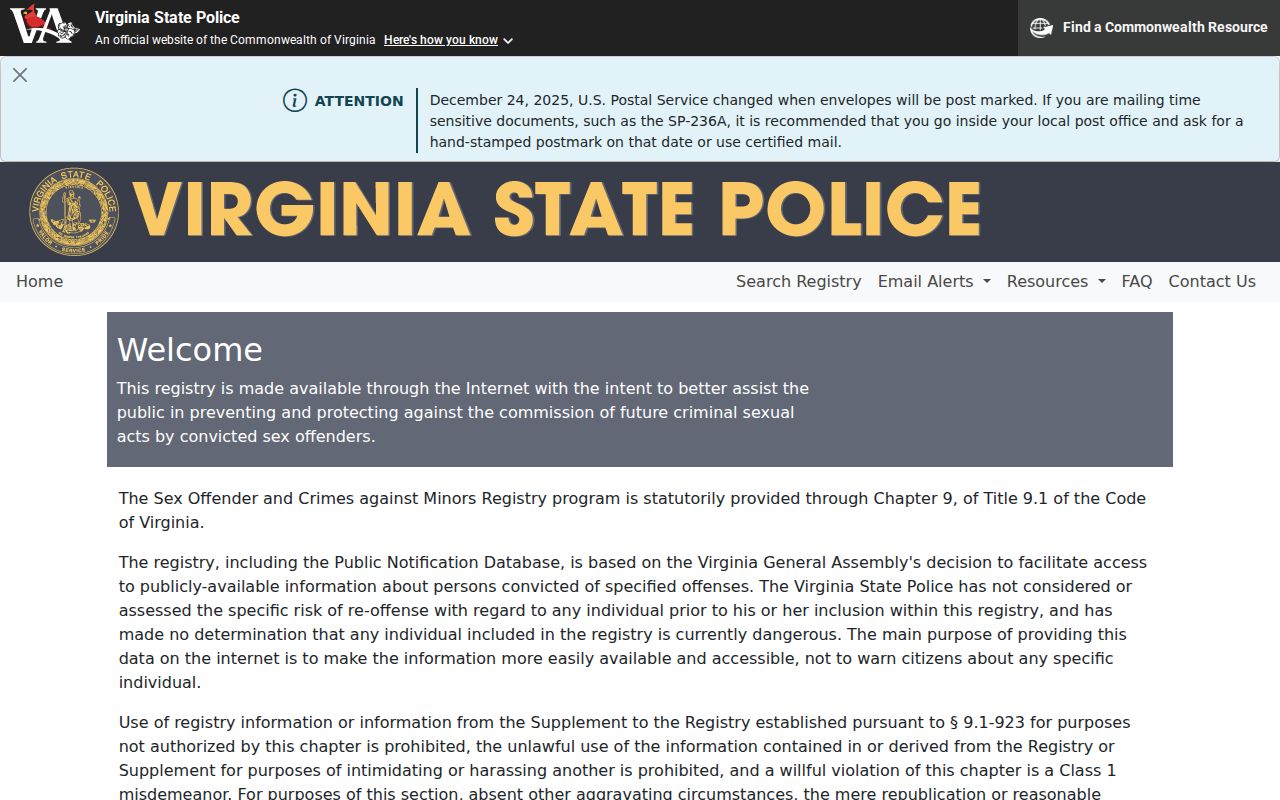
The state page also gives the limits that matter. Registry publication is statutory, profiles can change as agencies report updates, and the public result should be read as a record rather than a forecast of future behavior.
Searching the Virginia Sex Offender and Crimes Against Minors Registry
The registry accepts several routes. Use the least broad path that still answers the safety question, and check spelling before widening a query. A Lynchburg City location search requires at least one place field, while an identity search uses a paired first and last name or a registration number.
- Open the official VSP registry and select the search type that fits a name, address, neighborhood, or school inquiry.
- For an identity search, enter both first and last name, or use the registration number as the alternate key.
- For a local place search, choose LYNCHBURG CITY under County/Independent City and add an address, city, or ZIP Code as needed.
- Set the Search Filter only when a status group matters, then run the query and open the official profile.
- Read the conviction, address, work, school, photograph, alias, and registration fields together before drawing a conclusion.
| Field | Use | Key detail |
|---|---|---|
| Search Filter | Status group | All, homeless, wanted, incarcerated, civilly committed, or exclusions listed by VSP |
| First and Last Name | Identity route | Both are used together |
| Registration # | Identity route | May replace the name pair |
| Street, City, ZIP | Location route | At least one location field is needed |
| County/Independent City | Locality route | Select LYNCHBURG CITY |
The official Virginia registry search form displays these controls before any person-specific result. The manifest image below documents the search interface without republishing a registrant's name or photograph.
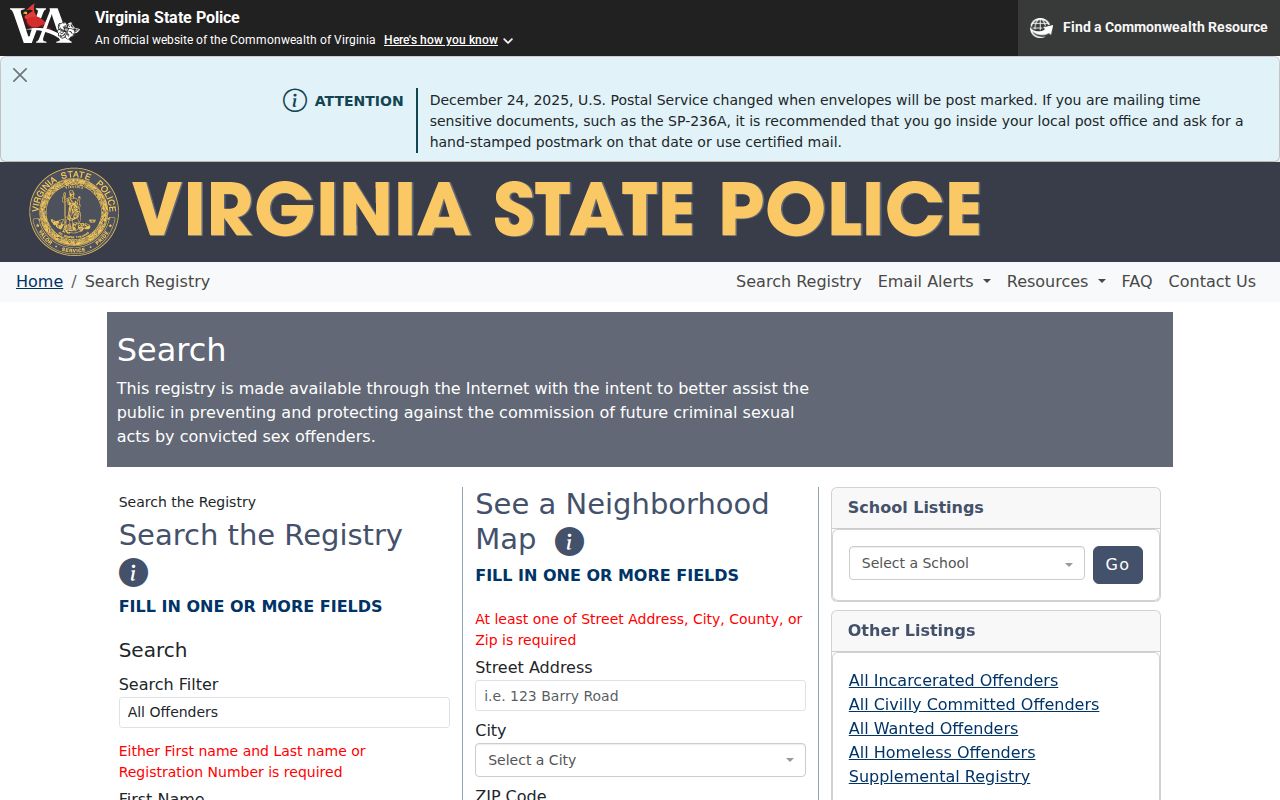
Search and Reset controls let a user refine a query without carrying old fields into the next attempt, which helps prevent false matches.
Lynchburg City Neighborhood Radius Searches
Virginia's Neighborhood/Location form supports precise local work. It accepts street address, city, ZIP Code, and County/Independent City, then offers radius choices of .25, .50, 1, 2, or 5 miles. This is useful near a home, park route, or campus. School search options in the Lynchburg area include University of Lynchburg, Virginia University of Lynchburg, and Liberty University.
The national Department of Justice National Sex Offender Public Website adds a cross-state name and ZIP search. Virginia does not supply coordinates to NSOPW for its radius function, so the national layer cannot replace Virginia's own address-radius tool for a Lynchburg City neighborhood check.
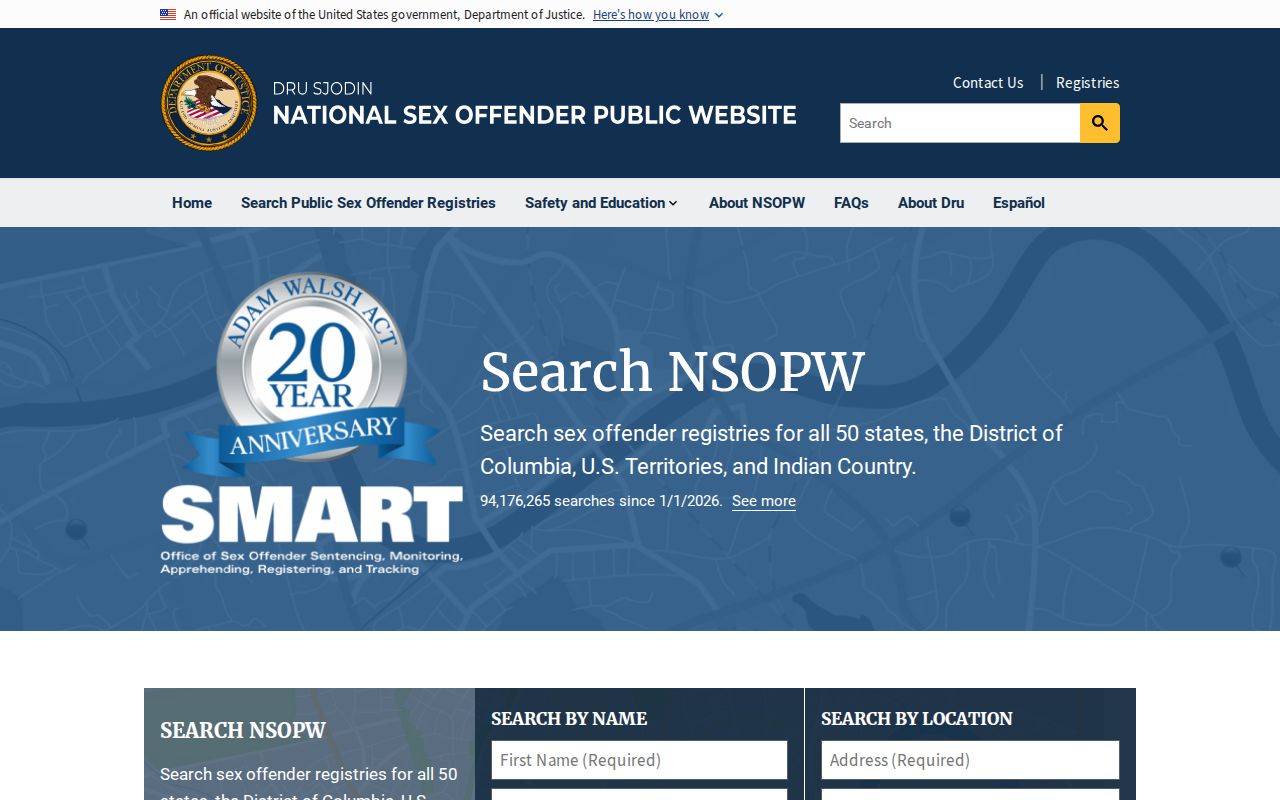
The national page is best used when a search may cross state lines. For a distance measured from a Lynchburg address, return to VSP's local radius form.
What a Registry Profile Shows
Virginia Code specifies a public set rather than every item held by law enforcement. A Lynchburg City registry profile can publish identity and location information needed for awareness while keeping repository-only identifiers outside the public display. Read the conviction locality and brief offense description as historical record fields, not as a statement about current conduct.
| Identity | Name, aliases, age, photograph, and public physical descriptors |
|---|---|
| Conviction | Conviction date and locality with a brief offense description |
| Current locations | Published home, work, and higher-education information where required |
| Registry status | Tier or registration status and wanted-for-failure-to-register notice when published |
| Tracking tools | Controls for email alerts and record monitoring |
Fingerprints, Social Security numbers, and internal mailing data may exist in the registry system, but they are not ordinary public profile fields. A public Lynchburg City result should never be supplemented with leaked or private identifiers.
Lynchburg City Registry Fields Under State Law
Virginia Code § 9.1-913 identifies information for Internet publication and directs VSP to update the public system each business day with new information. The official statute capture below provides the legal source for the public-field inventory rather than relying on a third-party summary.
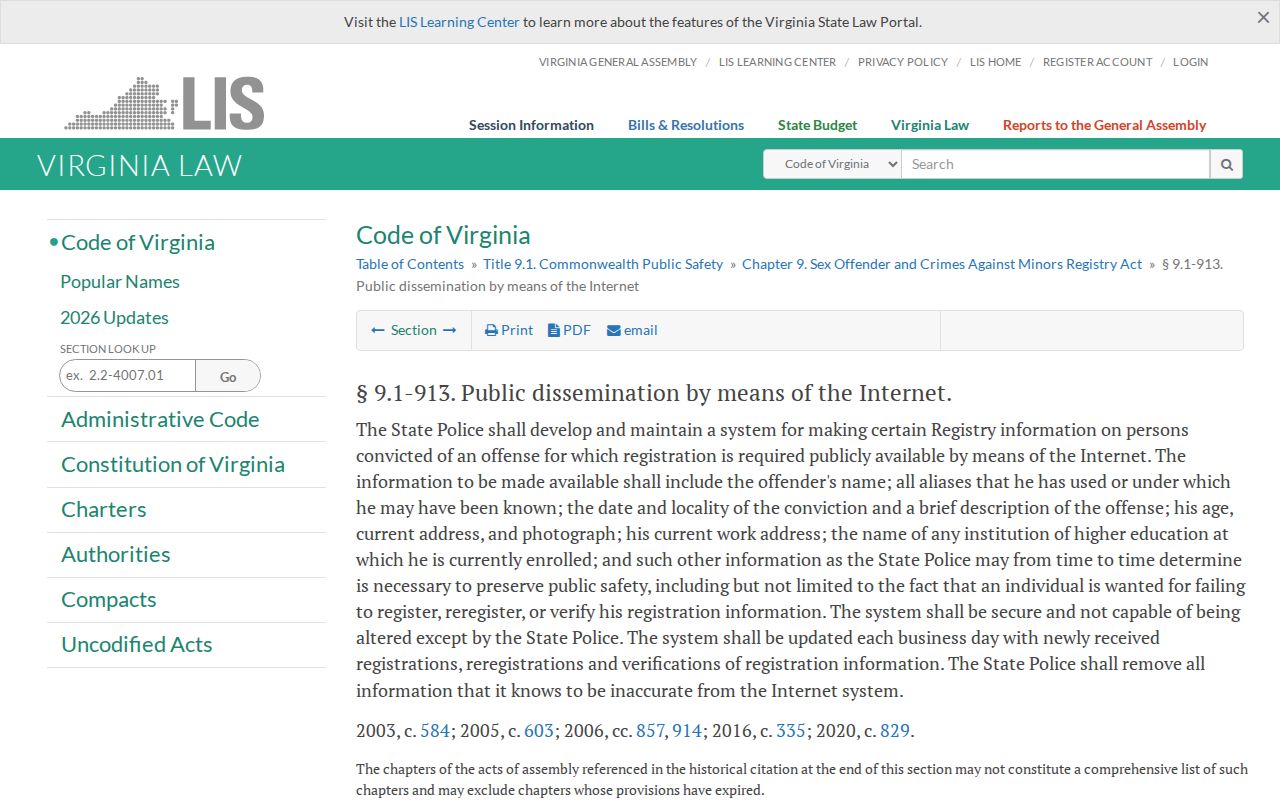
A business-day update duty does not mean each local change appears at once. Local agencies receive registration events and forward them to VSP, so a recent move or work change can still be in process.
Registration Requirements and Levels in Virginia
Virginia uses offense-based tiers. Tier is not an individualized risk score, and it should not be described as one. Verification frequency and possible removal rules differ by category, so both the tier and the qualifying conditions matter when reading a Lynchburg City profile.
| Virginia category | Verification | Duration or removal rule |
|---|---|---|
| Tier I | Annual in birth month | Possible court petition after 15 qualifying years for one eligible offense and satisfied conditions |
| Tier II | Annual in birth month | Possible court petition after 25 qualifying years for one eligible offense and satisfied conditions |
| Tier III | Quarterly, including birth month | Lifetime; ordinary removal under § 9.1-910 generally unavailable |
| Murder and specified highest categories | Quarterly | Lifetime |
The full Virginia Sex Offender and Crimes Against Minors Registry Act governs registration, verification, dissemination, and Internet publication. The official Act image below anchors those duties in the current code chapter.
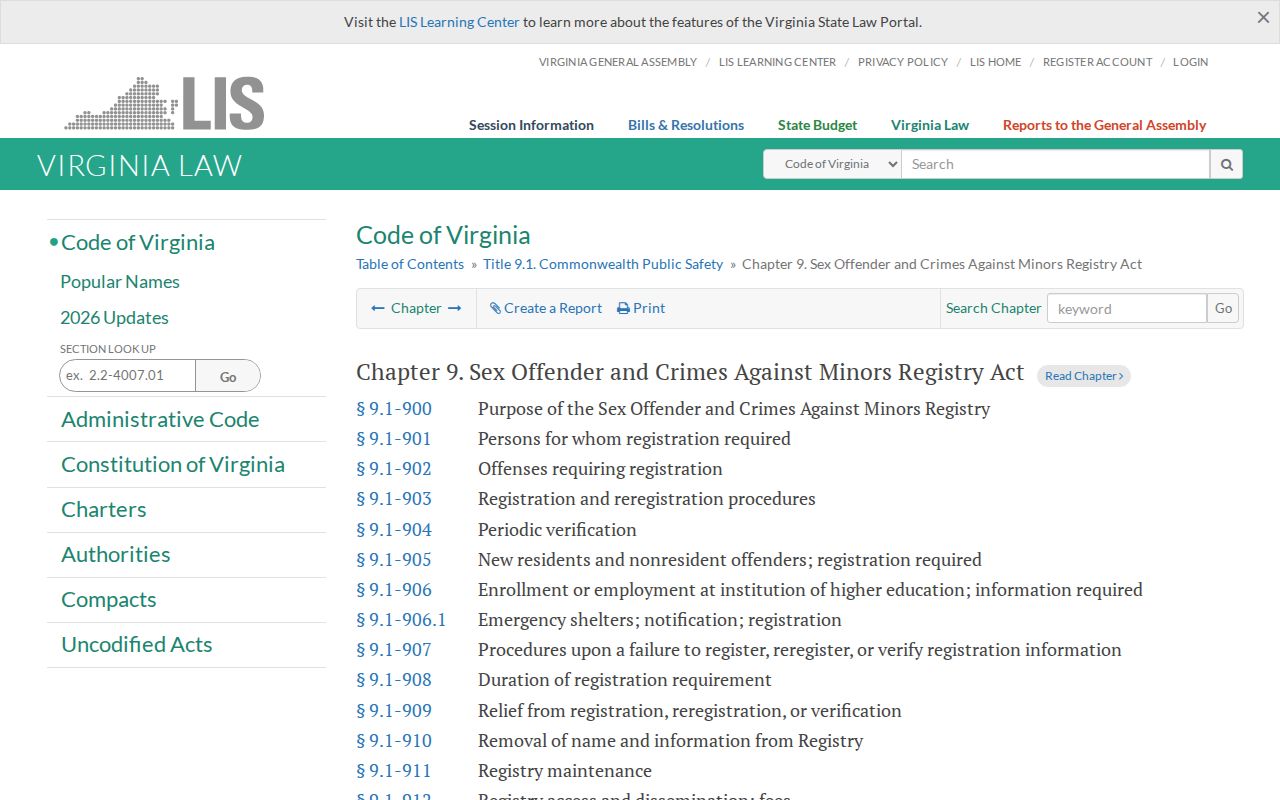
Removal is not automatic when a period passes. The person must fit the statute, satisfy its conditions, and obtain any court relief the category requires.
Lynchburg City Registry Email Alerts
VSP offers Register, Manage, and Unsubscribe controls for email alerts. A user may track a geographic area or a selected offender, including changes tied to home, school, or work. Address-radius alerts use the same .25-to-5-mile range available in the neighborhood search, while ZIP-based alerts cover a broader area.
Alerts are a monitoring aid, not a substitute for reading the current official profile. If an email describes a move, open the VSP record and confirm what changed. Save the registration number when it is available because it is a more precise lookup key than a common name.
Note: VSP's web alerts supplement the current profile, so reopen the official record before relying on an emailed change notice.
Report Lynchburg City Registration Concerns
A suspected address, work, school, or registration failure should go to law enforcement. Contact Lynchburg Police through an official department channel or call the VSP Sex Offender Registry unit at 804-674-2825. Give the public profile or registration number, the observed concern, and when it was seen. Do not investigate, confront, or publish extra personal details.
Not every apparent mismatch proves a crime. Updates can be pending, a profile may reflect a lawful status such as incarceration or homelessness, and the underlying duty depends on current law. The reporting agency can compare the tip with nonpublic registration records and decide whether follow-up is warranted.
Lynchburg City Registry Status Filters
The Search Filter can display all offenders or narrow the results to homeless, wanted, incarcerated, or civilly committed groups. It also offers an option that excludes civilly committed and incarcerated offenders. These labels describe current registry or custody status as published by VSP. They do not erase the need to read the full profile.
- Wanted
- A published failure-to-register status, not a label for every open warrant.
- Homeless
- A registration category that may require different address reporting and verification.
- Incarcerated
- A custody status that changes how a location result should be interpreted.
- Civilly committed
- A distinct legal status shown as its own filter, not a criminal conviction outcome.
Using a narrow filter can answer a focused question, but it can also hide other Lynchburg City profiles. Repeat the search with All Offenders when a complete local view is needed.
Lawful Use and Community Notification
Registry information supports lawful awareness. It does not license threats, harassment, retaliation, trespass, or a campaign against a listed person or that person's family. Virginia also cautions that VSP has not made an individualized prediction of current dangerousness. Base safety steps on conduct, context, and official guidance rather than tier alone.
Misuse is a crime. Virginia Code § 9.1-918 bars unauthorized use and use of registry information to intimidate or harass. A willful violation is a Class 1 misdemeanor.
Virginia has no sound one-line rule that every registrant must live a fixed distance from every school. Offense terms, supervision conditions, and conduct restrictions must be checked under current law. For personal safety, use the official search, set alerts when useful, and send suspected noncompliance to LPD or VSP.